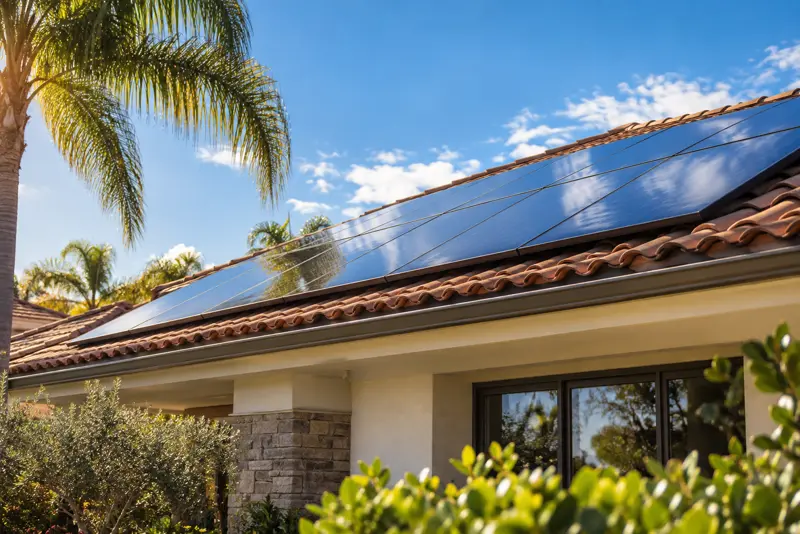
Solar panel cleaning · window add-on
Solar panel cleaning in Rancho Cucamonga
$6 a panel, cleaned from the ground with pure water. Single-story roofs only. We never go on your roof.
What it costs
Panels are $6 each, with a $110 minimum visit. A typical array of 16 panels is $110 one-time, and a plan takes 8% to 15% off. Add windows in the same visit and the whole visit is 10% off.
Launch pricing is being finalized by the owner
The rules we work by
- Single-story roofs only
- Cleaned from the ground with a water-fed pole
- No roof walking, ever
- No detergents or soaps on your panels
- No two-story roof arrays
Why panels lose output when they are dirty
Dust, ash and pollen settle on the glass and block some of the sunlight reaching the cells. In a dry climate with a long rain-free season, that film builds up for months. Researchers have measured it directly in California and the Southwest, and the size of the loss depends heavily on location, tilt, rainfall and how long since the last rain or cleaning.
- Soiling losses in the southwestern US build up gradually during dry weather, and large-system studies in California modeled accumulation on the order of 0.1 to 0.3 percent per day of dry weather before rain or cleaning resets it [1].
- A field study that monitored dirty and cleaned modules side by side in California found clear regional soiling trends, and examined how much rain it takes to recover performance [2].
- Across the world, soiling was estimated to cost at least 3 to 4 percent of solar generation in 2018, with losses much higher in dusty regions [3].
- NREL researchers have analysed how soiling varies by season across US sites, with the largest losses at the end of dry periods [4].
None of this means your panels have lost any specific amount. Your own numbers depend on your roof, the wind and how long since it last rained. We do not promise a percentage; we promise a clean panel. The easiest way to know is to look at your monitoring app before and after a visit.
Inland Empire specifics
Santa Ana winds blow mostly from October to March, peaking around October and November, and they are strongest near canyon mouths, which includes Rancho Cucamonga and Etiwanda. Dry hillsides and fire season add ash. The first light rain after a dry spell can turn that dust into a muddy film instead of washing it off.
Sources
- [1] Kimber, Mitchell, Nogradi and Wenger (2006), "The Effect of Soiling on Large Grid-Connected Photovoltaic Systems in California and the Southwest Region of the United States," IEEE 4th World Conference on Photovoltaic Energy Conversion. Link
- [2] Caron and Littmann (2013), "Direct Monitoring of Energy Lost Due to Soiling on First Solar Modules in California," IEEE Journal of Photovoltaics 3(1), 336-340. Link
- [3] Ilse, Micheli, Fayad et al. (2019), "Techno-Economic Assessment of Soiling Losses and Mitigation Strategies for Solar Power Generation," Joule 3(10). PDF
- [4] Micheli et al., "Seasonal Trends of Soiling on Photovoltaic Systems," NREL preprint. PDF
Why pure water
Pure water has had its dissolved minerals removed. It dries without spots or a film, so it needs no soap, and soap is the thing that can leave residue that holds dust. Regular tap water here is moderately hard to hard, around 142 mg/L average hardness in Rancho Cucamonga's 2023 report, and it would leave mineral spots on the glass as it dries. Many panel manufacturers' care instructions call for plain water and a soft brush, and harsh chemicals or abrasives can damage coatings. Check your own panel manual, because requirements differ, and we will follow it.
How a visit goes
Check the roof
We confirm it is a single-story roof and that we can reach the array from the ground. If not, we say so.
Brush and rinse
A water-fed pole with a soft brush scrubs the glass as pure water flows through it, then rinses it clean.
Dry-down
Pure water dries without spots, so there is nothing to wipe and nothing left behind.
Common questions
Why pure water for solar panels?
Pure water has had the minerals removed, so it dries without leaving spots or a film, and it does not need soap. Soaps can leave residue that attracts dust, and many panel makers recommend plain water and a soft brush in their care instructions. Check your own panel manual, since requirements differ.
Do you go on the roof?
Never. We clean panels from the ground with a water-fed pole, and only on single-story roofs. If your panels are on a two-story roof, we will tell you honestly that we cannot do them, and we will not send anyone up.
How often should panels be cleaned?
In dry, dusty Inland Empire air, many homeowners clean panels two to four times a year. Rain helps but does not clear everything, and the first light rain after a long dry spell can leave a muddy film. A plan puts it on autopilot.
Will cleaning make a big difference?
It depends on how dirty the panels are. Studies of soiling in California and the Southwest show measurable losses that grow during dry spells, but your result will vary. We do not promise a percentage.
Get your solar panel price.
Pick your windows or panels, then make it a plan. No card needed.